2026 Guide: Best Hitch Canoe Racks You'll Want to Have!
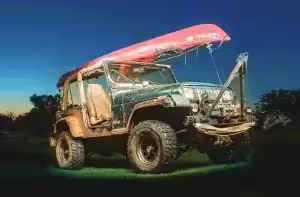
I still remember the morning I almost lost a canoe on I-90. It was early spring, the kind of gray Pacific Northwest dawn where you can barely see past your hood, and I had my Old Town lashed to a pair of foam blocks on the roof of a Subaru Outback that had seen better days. Every gust of crosswind made the boat shimmy, and I white-knuckled it for sixty miles before pulling off at a rest stop and seriously reconsidering my life choices. That was the trip that convinced me to invest in a hitch-mounted canoe rack — and honestly, it changed the way I haul boats forever.
If you've been wrestling canoes onto your roof, fighting with straps at shoulder height, or worrying about clearance in parking garages, a hitch rack might be exactly what you need. I've spent over a decade guiding whitewater trips and shuttling boats to put-ins across the country, and in that time I've loaded canoes onto just about every type of carrier imaginable. Hitch racks aren't perfect for every situation, but when they're the right tool, nothing else comes close.
Why a Hitch Rack Instead of a Roof Rack?
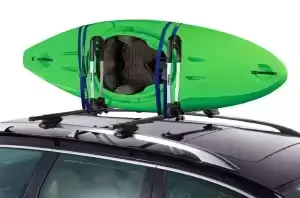
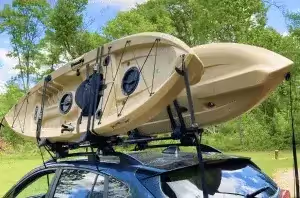
Let's get the obvious question out of the way first. Most paddlers start with a roof-mounted system — a set of J-racks or saddle cradles bolted to crossbars on top of the car. That works great for a lot of people, and I'm not here to trash roof racks. But there are real, practical reasons why a hitch-mounted system can be the better call.
Loading height. This is the big one. If you're hoisting a 75-pound Royalex canoe over your head and onto a roof that's six feet off the ground, you need to be reasonably tall, reasonably strong, and reasonably coordinated — ideally all three at once. I've watched paddlers in their twenties struggle with this, and I've watched folks in their sixties make it look easy, so it's not just an age thing. But a hitch rack sits at bumper height. You're lifting the boat to your waist, not over your head. That's a game-changer for solo paddlers, for anyone with shoulder issues, and honestly for anyone who's just tired of the overhead wrestling match at the end of a long day on the water.
Vehicle compatibility. Some vehicles just aren't great candidates for roof-mounted canoe carriers. I'm thinking of tall trucks and SUVs where the roof is already seven feet up, vans with curved roofs that make crossbar fitment tricky, and cars with panoramic glass roofs where you can't mount anything at all. If your vehicle has a 2-inch receiver hitch — or can have one installed — a hitch rack sidesteps all of those problems.
Less wind noise and drag. A canoe on the roof is a sail. There's no way around it. You'll hear the wind roar, you'll feel the car get pushed around, and your fuel economy will take a hit. A hitch-mounted canoe rides lower and behind the vehicle, partially in its wind shadow. It's not silent, but it's noticeably better.
No roof damage. I've seen crossbar mounts leave marks on paint, I've seen improperly tightened clamps crack trim pieces, and I've seen rainwater pool around mounting points and cause rust. A hitch rack puts zero stress on your roof.
The Trade-Offs You Should Know About
I'd be doing you a disservice if I didn't cover the downsides, because there are a few that matter.
- Rear visibility: A canoe sticking out behind your vehicle on a hitch rack will block some or all of your rearview mirror. You'll be relying on side mirrors, which is fine on the highway but takes some getting used to in parking lots and at tight put-in access roads.
- Overall vehicle length: Your rig just got 8-10 feet longer. Think about that before you pull into a drive-through or a compact parking space. I learned this the hard way at a Wendy's in West Virginia.
- Hitch requirement: You need a receiver hitch, typically a 2-inch Class III. If your vehicle doesn't have one, installation runs $200-$400 at most shops, plus the cost of the hitch itself. Worth it if you're going to use it, but it's an upfront investment.
- Weight on the hitch: Most Class III hitches are rated for 350-500 pounds of tongue weight, and a canoe plus rack will be well within that. But if you're also towing or carrying a bike rack, you need to do the math.
Types of Hitch Canoe Racks
Not all hitch racks are created equal, and I've used enough of them to have strong opinions. Here's how I break down the category.
Vertical Post Systems
These are the most common design. A vertical post — sometimes a T-bar, sometimes a single upright — slides into your hitch receiver and extends up to about roof height. Your canoe sits on padded arms or cradles that attach to the post. The boat rides vertically or at a slight angle behind the vehicle.
The beauty of this design is simplicity. There aren't a lot of moving parts, the canoe is held securely by straps or ratchet tie-downs, and the whole assembly folds down or removes quickly when you're not using it. I've been running a vertical post system for group trips where I need the roof rack for a second boat, and it works perfectly as a supplemental carrier.
Horizontal Extension Arms
Some hitch racks extend horizontal arms out from the receiver, essentially creating a rear-mounted crossbar system. Your canoe sits flat across these arms, the same way it would on a roof rack. This design is less common for canoes specifically, but it works well if you're carrying a wider boat and want maximum stability. The downside is that horizontal arms extend the width of your vehicle, so you need to be mindful of lane width and passing clearance.
Combination Hitch Carriers
A few manufacturers make hitch racks that can carry a canoe plus bikes, or a canoe plus cargo. If you're the kind of paddler who also mountain bikes or camps with a lot of gear, these multi-use systems can be incredibly efficient. They tend to be heavier and more expensive, but the versatility is hard to beat. I used one for a season when I was running weekend trips that involved both paddling and cycling, and not having to swap carriers between activities saved me a lot of frustration.
My Top Hitch Canoe Rack Picks for 2026
Yakima LongArm
The LongArm has been my go-to recommendation for a few years now, and the current version is the best yet. It extends from a 2-inch hitch receiver and provides a bed-extender style platform that supports canoes up to 18 feet. What I like most is the loading angle — you slide the boat on from the rear, so you're never lifting above waist height. The build quality is excellent, the padding protects the hull, and it folds up reasonably compact when not in use. It runs around $350-$450 depending on where you buy it, which is mid-range for a quality hitch carrier. If you want to understand how this compares to other carrier types, check out our overview of all rack types.
Thule Goalpost
Thule's Goalpost is a T-bar style hitch rack that's been a staple for canoe paddlers for years. It's a simple, clean design — a vertical post with a horizontal crossbar at the top, and you strap your canoe to the crossbar with cam buckle straps or ratchet straps. It's rock solid, I've driven thousands of miles with canoes on a Goalpost without a single issue, and it's one of the more affordable hitch options at around $250-$300. The downside is that loading still requires lifting the canoe up to the crossbar height, which is about 4-5 feet off the ground. Better than a roof, but not as easy as a true low-loading system.
Malone Telos XL
Malone has been quietly making excellent, affordable racks for years, and the Telos XL is their flagship hitch canoe carrier for 2026. It supports canoes up to 85 pounds, has adjustable padding, and includes tie-down straps in the box — something that not all manufacturers do. At around $200-$280, it's the budget pick that doesn't feel like a budget pick. I used a Malone rack for an entire season of instructor training on the New River, loading and unloading twice a day, and it held up without any issues.
Rhino-Rack T-Loader
If you want a hitch rack that also functions as a loading assist, the Rhino-Rack T-Loader is worth a look. It has a tilting mechanism that lets you lower the crossbar to load the canoe, then ratchet it back up to driving position. It's a clever design that splits the difference between a standard hitch rack and a lift-assist system. Price is in the $300-$400 range, and build quality is solid.
How to Choose the Right One
After selling and recommending hitch racks for years, here's the decision framework I use with my students and fellow guides.
If you paddle solo and loading ease is your top priority, go with a system that loads at bumper height — the Yakima LongArm or a similar bed-extender style. You'll thank yourself at the end of a long day when your arms are cooked from paddling and you just want to get the boat on the car and get home.
If you're on a budget, the Malone Telos or a similar sub-$300 T-bar system will serve you well. These are proven designs that have been refined over many product generations, and the build quality at this price point has gotten remarkably good.
If you need to carry multiple boats, consider pairing a hitch rack with a roof system. I regularly run a canoe on the hitch and a kayak on roof-mounted J-racks for trips where I want both boats available. This is also a great setup for families — the big tandem canoe goes on the hitch where it's easier to load, and the kids' kayaks go on top.
If you have a truck with a bed, you might actually be better served by a bed extender than a traditional hitch rack. But if your bed is full of camping gear — which, let's be honest, it usually is — the hitch rack keeps your cargo space free.
Installation and Setup Tips
I've installed more hitch racks than I can count, and here are the things I wish someone had told me the first time.
- Use a hitch pin with a lock. The standard clip pins that come with most hitch receivers work fine for keeping the rack in place, but they're easy to steal. A locking hitch pin costs $15-$25 and gives you peace of mind when you're on the water for hours.
- Check your hitch for wobble. Some receiver hitches have a little play in them, and that wobble gets amplified over the length of the rack and canoe. An anti-wobble hitch device (around $20) tightens up the fit and makes the whole system more stable at highway speeds.
- Add a flag or light. If your canoe extends more than 4 feet past your rear bumper — and with most hitch racks, it will — most states require a red flag or light on the end of the overhang. I use a bright orange rag tied to the stern. It's low-tech but it works and it's legal everywhere I've paddled.
- Practice loading at home first. Don't figure out your loading technique for the first time in a muddy parking lot at the put-in with other paddlers waiting behind you. Load and unload the canoe a few times in your driveway until it feels natural.
Hitch Rack vs. Roof Rack: The Real-World Comparison
I get asked this question constantly, so here's my honest breakdown based on years of using both.
Roof racks are better when you need to carry multiple boats and want to keep your rear clear for backing up, towing, or accessing a tailgate. They're also the only option if you don't have a hitch receiver and don't want to install one. For a deeper dive on the full range of options, our cost guide breaks down what you'll spend on each type of system.
Hitch racks are better when loading ease is a priority, when your vehicle's roof isn't ideal for mounting, or when you want to keep your roof free for cargo boxes or other accessories. They're also generally faster to install and remove — most hitch racks go from box to ready in under 20 minutes, while a full roof rack system can take an hour or more to set up the first time.
For what it's worth, I currently run both. My daily driver has J-racks on the roof for quick after-work paddles with a single kayak, and I keep a hitch rack in the garage for canoe trips and multi-boat adventures. Having both options has made my paddling life significantly easier.
A hitch-mounted canoe rack isn't the right answer for every paddler, but for the situations where it shines — solo loading, tall vehicles, long drives, multi-boat setups — it's genuinely hard to beat. I've hauled canoes across dozens of states on hitch racks, through rainstorms and crosswinds and on sketchy dirt roads to remote put-ins, and I've never once wished I was wrestling a boat onto my roof instead.
If you're on the fence, think about what frustrates you most about your current setup. If it's the overhead lifting, the wind noise, or the anxiety about roof-mounted straps holding at 70 mph, a hitch rack addresses all three. Pick one that fits your budget and your hitch, practice loading it a few times at home, and then go find some water. That's the whole point of all this gear, after all — getting the boat to the river so you can spend less time in the parking lot and more time on the water.