How Much Do Kayak Racks Cost? 2026 Price Guide
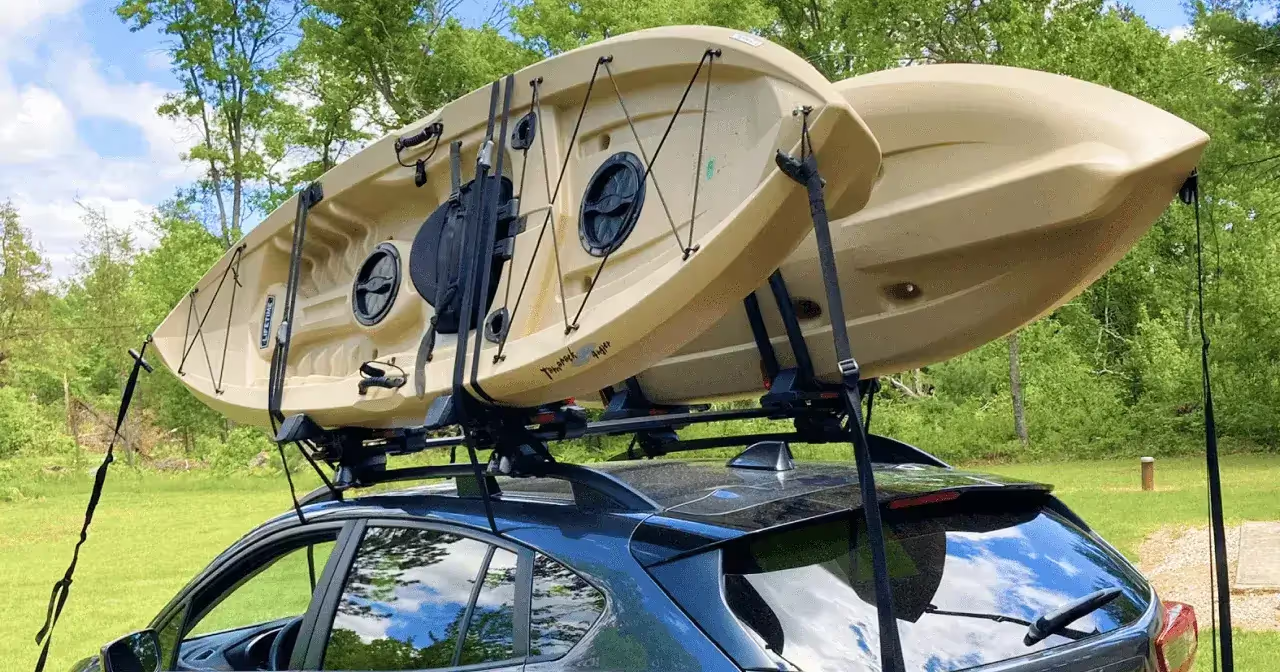
Every paddler eventually has the same moment of sticker shock. You've just dropped $600-$1,500 on a kayak, you're feeling great about it, and then you realize you need to get the thing home — and to the water — on a regular basis. So you start looking at racks, and suddenly you're staring at price tags that range from $40 to $800, with absolutely no obvious explanation for why one piece of metal costs twenty times more than another. I've been there. Every paddler I've ever guided has been there.
The truth is, kayak rack pricing makes a lot more sense once you understand what you're actually buying. Not all racks do the same thing, not all racks fit all vehicles, and the sticker price often doesn't include everything you need to actually mount the rack and get on the water. I've spent over a decade buying, testing, recommending, and occasionally returning kayak racks, and I'm going to break down exactly what things cost in 2026 so you can budget accurately and avoid the unpleasant surprise of hidden costs.
The Full Price Picture: What You're Actually Paying For
Before we get into specific rack types, let's talk about the total system cost, because this is where most people get tripped up. A kayak rack system typically has three components, and you might need to buy all three.
1. The rack/carrier itself. This is the J-rack, saddle cradle, stacker, or hitch carrier that actually holds your kayak. It's the thing pictured on the box and the price you see advertised.
2. The crossbars. Most roof-mounted racks attach to crossbars that run across the width of your vehicle's roof. Some vehicles come with factory crossbars. Many don't. If yours doesn't, you'll need to buy a crossbar system separately, and this can cost as much as or more than the rack itself.
3. The fit kit or mounting hardware. Crossbars need to attach to your specific vehicle, and the mounting method varies depending on your roof type (raised rails, flush rails, fixed points, bare roof, rain gutters). Most crossbar systems require a vehicle-specific fit kit that costs $40-$100 on top of the crossbar price.
So when you see a J-rack advertised for $120, the actual cost might be $120 (rack) + $250 (crossbars) + $80 (fit kit) = $450. That's a very different number, and it catches a lot of first-time buyers off guard.
Cost by Rack Type
J-Style Kayak Carriers: $80-$250
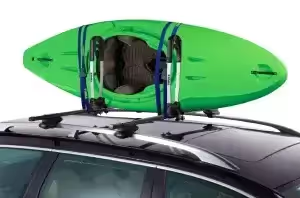
J-racks are the most popular style of kayak carrier, and they span a wide price range. At the low end, around $80-$120, you'll find basic J-cradles from brands like Malone and SportRack. These are functional, straightforward, and perfectly adequate for recreational paddlers who make a handful of trips per season. The padding is thinner, the hardware is simpler, and the aesthetics are basic, but they hold a kayak securely and that's what matters.
In the mid-range, $130-$180, you get carriers like the Thule Hull-a-Port XT and the Yakima JayLow. These offer better padding, smoother loading mechanisms, tool-free mounting, and more refined designs. If you paddle regularly — say, 15-30 trips per year — this is the sweet spot for value.
At the high end, $180-$250, you're looking at premium J-racks with features like adjustable angles, integrated bow/stern tie-down points, and corrosion-resistant coatings. These are overkill for most recreational paddlers, but if you're loading and unloading frequently or carrying an expensive composite kayak that you want to baby, the extra features and build quality justify the price.
Horizontal Saddle/Cradle Racks: $100-$300
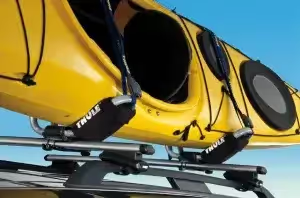
Saddle racks hold your kayak flat (right-side up) in padded cradles. They're generally more expensive than J-racks because you're buying more material — four separate saddle pads and cradles instead of two J-shaped arms. But they offer superior stability, better hull support, and easier loading since you don't have to tilt the kayak on its side.
Budget saddle systems from Malone and Sportrack run $100-$150. Mid-range options from Thule and Yakima are $150-$220. Premium systems with memory foam padding and tool-free installation hit $220-$300. I've used the Thule Compass at the $180 price point for several seasons and it's been excellent — great padding, quick to mount, and it handles everything from narrow whitewater boats to wide recreational kayaks.
Stacker Racks: $150-$400
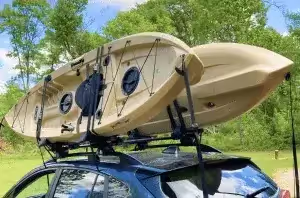
Stackers are designed for carrying multiple kayaks, and they're priced accordingly. The high-capacity rack guide covers these in detail, but from a cost perspective, you're looking at $150-$200 for a basic stacker post and $300-$400 for a premium system with integrated straps and padding. Given that a stacker replaces the need for multiple individual carriers, the per-boat cost is actually quite reasonable.
Hitch-Mounted Carriers: $200-$500
Hitch carriers tend to be the most expensive rack type because they're essentially self-contained systems — no crossbars required, no fit kits, no compatibility headaches. You have a hitch, you slide the carrier in, done. The simplicity and loading ease come at a premium.
Basic hitch T-bar systems start around $200. Mid-range carriers with better padding and loading features run $300-$400. Top-of-the-line hitch systems with tilting mechanisms and multi-boat capacity can hit $450-$500. But remember — there's no crossbar or fit kit cost on top of these prices, so the total system cost is often comparable to a mid-range roof-mounted setup.
Lift-Assist Systems: $350-$600
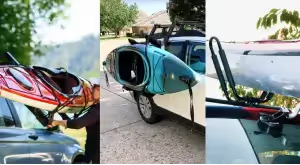
Lift-assist racks like the Thule Hullavator Pro and the Yakima ShowDown are the most expensive carriers on the market, and they earn that price with gas-assist struts that lower the cradle to loading height and then lift the kayak up to the roof. If overhead loading is a physical barrier for you — bad shoulders, shorter stature, heavy kayak, or a tall vehicle — these systems are worth every dollar. But they're a genuine investment, typically $400-$600 per side.
The Hidden Costs Nobody Talks About
Crossbars: $150-$400
If your vehicle doesn't have factory crossbars, this is the cost that'll sting the most. Quality crossbar systems from Thule and Yakima run $200-$400 depending on your vehicle and bar style. Budget crossbars from Malone and SportRack are $150-$250. You can sometimes find universal crossbar kits for $100-$150, but fitment and quality vary widely — I'd be cautious with the really cheap ones.
Before you buy, check whether your vehicle has factory crossbars or roof rails. Many SUVs and wagons come with raised or flush roof rails that can accept crossbars without a separate fit kit, which saves $50-$100. Some vehicles come with crossbars already installed from the factory, in which case you just need the carrier itself.
Fit Kits: $40-$100
If you need aftermarket crossbars, you'll almost certainly need a vehicle-specific fit kit. These are the brackets, clips, or pads that adapt a universal crossbar system to your particular make, model, and year. They're specific enough that a 2024 Rav4 might use a different fit kit than a 2026 Rav4, so double-check compatibility.
Straps and Tie-Downs: $15-$50
Some racks come with straps. Many don't. A set of quality cam buckle straps runs $15-$25, and I'd recommend having at least two sets — one for the crossbar straps and one for bow/stern tie-downs. Ratchet straps are $20-$40 for a pair. Don't use bungee cords. Ever. They stretch, they don't hold, and I've seen them snap and cause injuries. Bungee cords are for holding a tarp on a woodpile, not for securing a kayak at highway speeds.
Locks: $30-$60
Rack locks keep your carrier from being stolen off your crossbars, and cable locks secure your kayak to the rack when you're away from the vehicle. Neither is strictly necessary, but if you're leaving your rack on the car full-time or parking at trailheads while you paddle, they provide peace of mind. Thule and Yakima both sell lock sets that match their rack systems.
Hitch Installation: $200-$500
If you're going with a hitch-mounted carrier and your vehicle doesn't have a hitch receiver, you'll need one installed. The hitch itself costs $100-$250 for most passenger vehicles, and professional installation adds $100-$250. Some mechanically inclined paddlers install their own hitches — it's a manageable DIY project on most vehicles — but you need to be comfortable working underneath the car with a torque wrench.
Total System Costs: Realistic Budgets for 2026
Here's what you should actually budget for a complete, ready-to-use kayak transport system in 2026, based on the most common scenarios I see.
Budget setup (vehicle with factory crossbars): $80-$150 for a basic J-rack or saddle carrier, plus $15-$25 for straps. Total: $95-$175.
Mid-range setup (vehicle without crossbars): $130-$200 for a quality carrier, $200-$300 for crossbars and fit kit, $20-$40 for straps. Total: $350-$540.
Premium roof setup: $200-$300 for a top-tier carrier, $300-$400 for premium crossbars, $80-$100 for fit kit, $40-$60 for straps and locks. Total: $620-$860.
Hitch carrier setup: $250-$450 for the carrier, possibly $200-$500 for hitch installation if needed. Total: $250-$950 depending on whether you already have a hitch.
Lift-assist setup: $400-$600 for the carrier, $200-$400 for crossbars if needed. Total: $400-$1,000.
New vs. Used: Where to Find Deals
Kayak racks are one of those products where buying used can save you serious money without much risk. Unlike electronics or clothing, a metal rack doesn't become obsolete or wear out quickly. A five-year-old Thule J-rack works exactly the same as a new one — the padding might be slightly compressed, but the structural components are essentially immortal.
I've bought used racks from Craigslist, Facebook Marketplace, and at paddling club swap meets, and I've gotten 50-70% off retail prices consistently. The key is to check for bent metal, cracked plastic components, and missing hardware. If the rack is structurally sound and all the parts are there, it's a great deal.
Also worth checking: REI's used gear site and outlet, Backcountry's outlet section, and end-of-season sales at local outdoor retailers. Kayak racks tend to go on sale in September and October when paddling season winds down in most of the country.
When to Splurge and When to Save
After years of buying and recommending racks at every price point, here's my honest advice on where your money makes the biggest difference.
Splurge on crossbars. Cheap crossbars flex, rattle, and sometimes don't fit well. Quality crossbars from Thule or Yakima are solid, quiet, and properly engineered for your vehicle. They're also the foundation of your entire system — everything else mounts to them.
Save on carriers if you paddle casually. If you're making 5-10 trips per year, a $100 J-rack from Malone will serve you just as well as a $250 Thule. The expensive carriers justify their cost through better loading mechanisms, more durable padding, and features like tool-free mounting that matter when you're loading and unloading frequently.
Splurge on a lift-assist if you need one. If overhead loading is genuinely difficult for you — and there's no shame in that — a lift-assist rack is a quality-of-life upgrade that will keep you paddling for years longer than you would with a standard carrier. Don't let the price talk you out of the thing that keeps you on the water.
The reality of kayak rack pricing in 2026 is that you can build a perfectly functional, safe transport system for under $200 if your vehicle cooperates, or you might need to budget $500-$1,000 for a complete setup on a vehicle that starts with nothing. Neither number is unreasonable when you consider that this is the system keeping a several-hundred-dollar kayak attached to your vehicle at highway speeds — it's not the place to cut corners on quality for the sake of saving fifty bucks.
My advice? Figure out your total system cost before you buy anything. Check whether your vehicle has crossbars, check whether you need a fit kit, and factor in straps and tie-downs. Then buy the best system you can afford within that total budget. You'll use it for years, possibly decades, and the peace of mind of knowing your boat is secure every time you merge onto the highway is worth more than any price difference between a budget rack and a mid-range one.